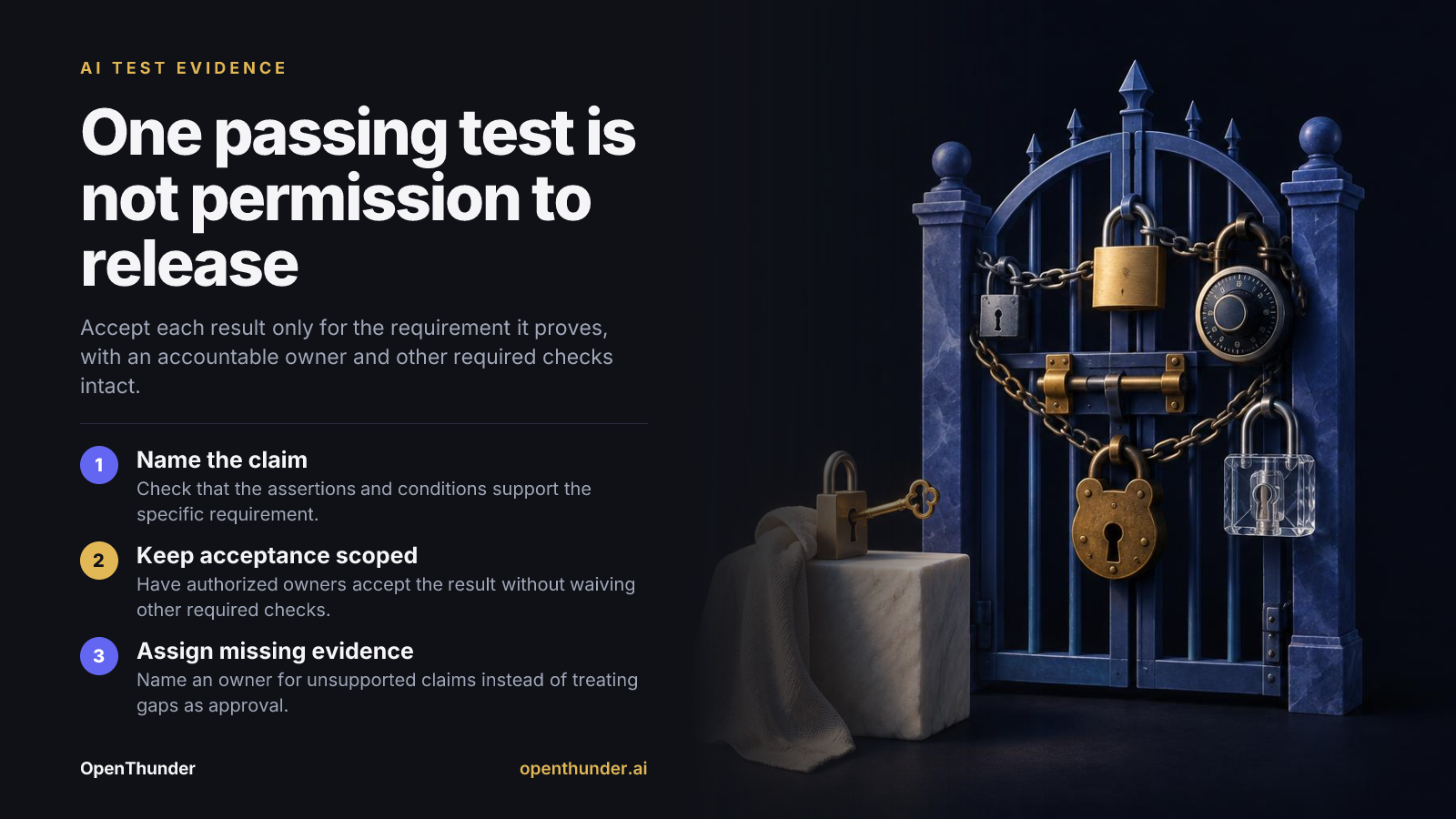
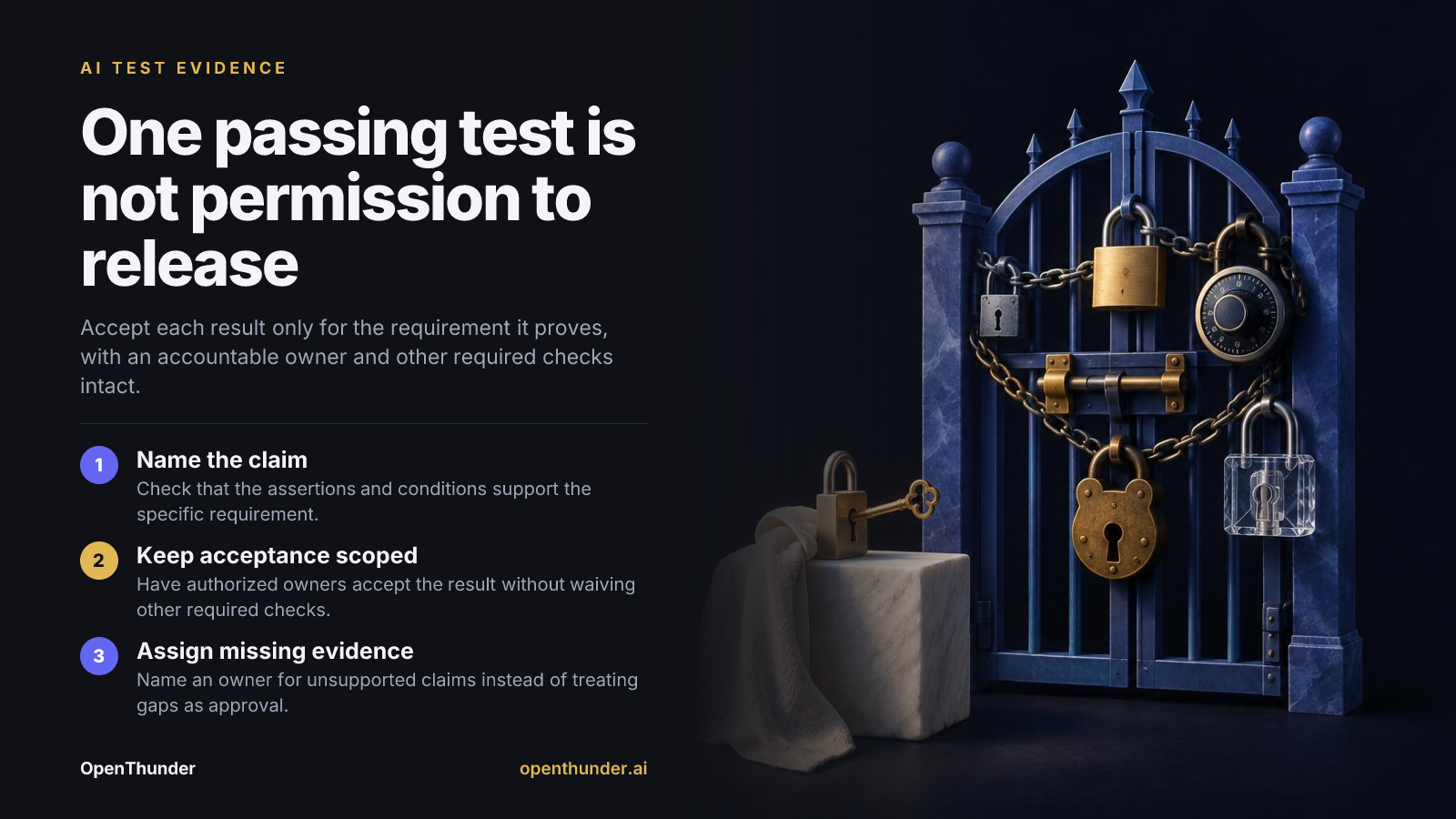
Summary slide. Accept each result only for the requirement it proves, with an accountable owner and other required checks intact. Artwork is AI-generated; every word on the slide comes from this article. Save the slide (PNG)
In an illustrative checkout test, one simulated payment produces a confirmation page. That pass says nothing about whether retrying the payment could create a duplicate charge.
Accept AI-generated test results as evidence for specific requirements, not as blanket permission to release. The decision is narrower than whether to adopt an AI coding tool: which claim may this result support, and who can accept it?
One checkout pass supports R1, not R2
Hypothetical assumptions: A checkout change must satisfy two requirements. R1 requires a confirmation after a successful payment response. R2 requires duplicate-charge prevention when the same payment operation is retried. All testing uses isolated resources and simulated payments.
The AI-generated happy-path test sends one payment request, receives a simulated success response, and verifies the confirmation page. Its retained record identifies the build, test definition, inputs, assertions, and execution logs. The checkout owner confirms that the assertions support R1.
The decision is scoped:
| Requirement | Available evidence | Owner and action |
|---|---|---|
| R1: Confirmation after success | Happy-path result accepted for this requirement. | Checkout owner records acceptance; release approver checks its applicability to the candidate build. |
| R2: Duplicate-charge prevention | No retry test or relevant payment-state evidence. | Payments owner defines the retry conditions and supplies evidence that checks the resulting simulated charge state. |
The happy-path pass stays valid within its scope. It does not close R2. If R2 is a mandatory release gate, the release remains blocked unless an authorized exception process explicitly permits and records a different decision.
Accepting R1 is not permission to waive R2.
This distinction matters even when a test is generated and executed correctly. A test can accurately answer the wrong question, or answer only part of the right one. If the test and its expected result come from the same mistaken interpretation, successful execution does not resolve that mistake.
I would accept AI-generated tests requirement by requirement, rather than approve a tool’s output as a blanket category of release evidence. This does not require humans to write every test. It requires an accountable owner to validate what the test is meant to prove.
The announcement raises the question, not the acceptance standard
OpenAI’s publisher excerpt for “Greptile takes bug detection beyond code review with GPT-6 Astra” describes Greptile using GPT-6 Astra to test user workflows, Daybreak to strengthen security, and Codex to reduce rework. That description frames AI-assisted review as extending into workflow testing.
The excerpt alone does not establish effectiveness, independence, coverage, retained evidence, or authority to approve a release. It also does not show how expected results are determined. Those limits matter: a publisher’s description of a capability is not evidence that a particular release requirement has been satisfied.
The governance decision stands independently of that announcement. Define evidence-acceptance rules before connecting a reported pass to a release gate.
Use the Claim-to-Gate Matrix: four signals and one decision
Attach this matrix to any workflow result proposed as evidence for a release requirement. A link to a retained record can satisfy a field; the information need not be copied into every release ticket.
| Signal | What the acceptance record must establish |
|---|---|
| Claim and expected outcome | Requirement tested: Name the requirement, precise behavior claimed, and relevant conditions. Expected-result owner: Identify the accountable person who confirms that the expected outcome matches the requirement, rather than merely current behavior. |
| Execution provenance | Test author: Record which tool or person generated the test, its retained version, and subsequent edits. Authorship alone establishes no independence. Build and environment: Identify the tested build, relevant configuration, dependencies, and isolated test environment sufficiently to assess applicability to the release candidate. Reproducible steps: Retain inputs, setup, actions, assertions, and reset steps sufficient to attempt a rerun; identify external dependencies and nondeterminism. |
| Artifacts and limits | Retained artifacts: Keep the test definition and execution records needed to inspect the claim, such as assertion results, relevant logs, and simulated transaction records. Exclude secrets and live customer data. Coverage limits: State the scenarios, failure conditions, integrations, and relevant policies the test does not address, including limits on applying the result to the release candidate. |
| Acceptance authority | Release approver: Identify the person authorized under team policy to accept this evidence, plus any separately required domain or security approval. Record acceptance of the scoped claim without silently waiving other checks. |
A complete record is necessary, but insufficient. The assertions, observations, and test conditions must justify the named claim. Traceability makes evidence inspectable; it does not make the test complete or its conclusions correct.
After reviewing the four signals, record one of these statuses for each requirement:
| Status | When to use it | Release consequence |
|---|---|---|
| Supplementary evidence | The result is useful, but its requirement mapping, expected outcome, or execution record is not yet validated. | It may guide investigation or review; it does not satisfy a required gate. |
| Accepted for a defined requirement | The matrix is complete, the assertions and observations under the recorded conditions support the claim, and authorized owners accept the result. | It can satisfy the relevant evidence obligation within its recorded scope. Other required checks remain in force. |
| Cannot satisfy this gate | The test addresses a different condition, lacks essential provenance, or fails a gate-specific requirement. | Obtain suitable evidence, or use an explicitly authorized exception process if one exists. |
A result may be accepted for one requirement and unable to satisfy another. That is scoped evidence, not a contradiction.
Keep authority explicit. The engineering owner accepts functional evidence within their remit. The relevant domain owner assesses domain-specific claims. Security approval remains with the designated security authority wherever policy requires it. A tool’s recommendation does not transfer those responsibilities.
Untested does not mean failed. It means unestablished.
If a required claim remains unsupported, record who owns the missing evidence and what decision is needed. An empty evidence field is not implicit approval.
Try one scoped decision in five minutes
Take one recent workflow pass and fill in the four signals for a single requirement. Check whether the assertions, observations, and conditions support that claim, not merely whether every field contains text.
This exercise exposes gaps in the record; it does not establish test adequacy by itself. Record either one scoped acceptance by the authorized owner or one missing-evidence request with a named owner.
Save the field guide
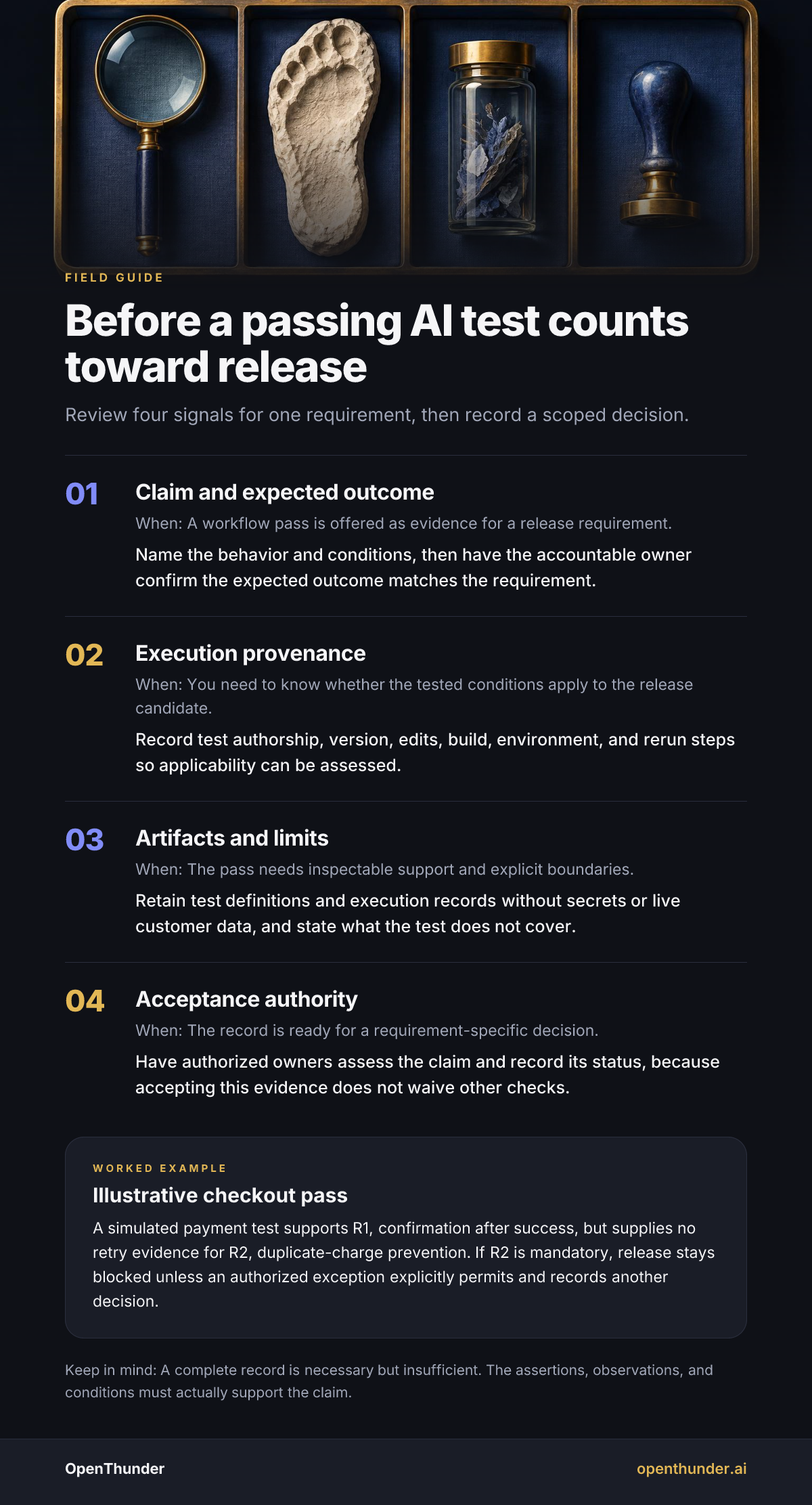
A field guide distilled from this article. The text version follows below.
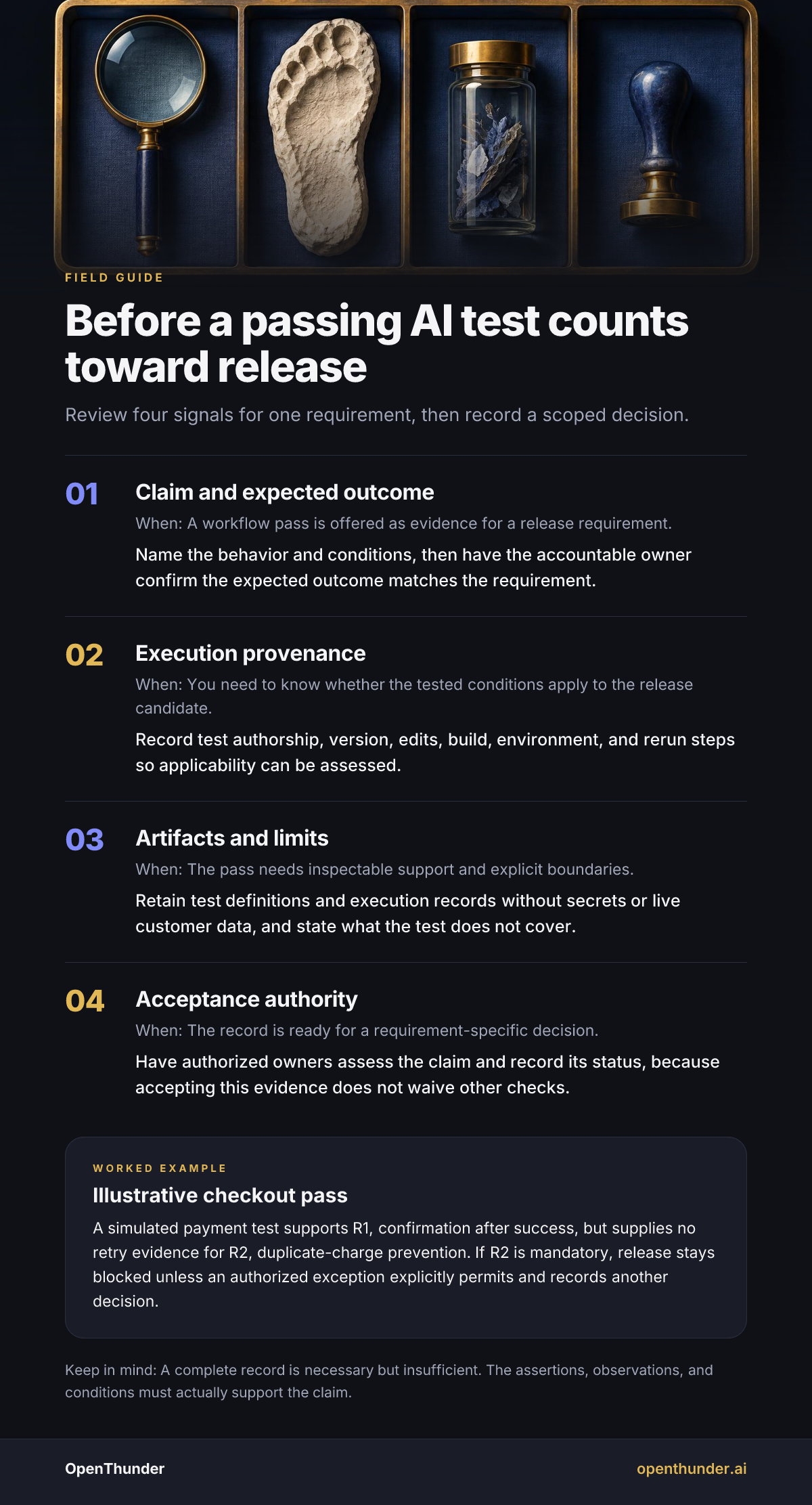
Text version
- Claim and expected outcome: A workflow pass is offered as evidence for a release requirement. Name the behavior and conditions, then have the accountable owner confirm the expected outcome matches the requirement.
- Execution provenance: You need to know whether the tested conditions apply to the release candidate. Record test authorship, version, edits, build, environment, and rerun steps so applicability can be assessed.
- Artifacts and limits: The pass needs inspectable support and explicit boundaries. Retain test definitions and execution records without secrets or live customer data, and state what the test does not cover.
- Acceptance authority: The record is ready for a requirement-specific decision. Have authorized owners assess the claim and record its status, because accepting this evidence does not waive other checks.
Illustrative checkout pass: A simulated payment test supports R1, confirmation after success, but supplies no retry evidence for R2, duplicate-charge prevention. If R2 is mandatory, release stays blocked unless an authorized exception explicitly permits and records another decision.
A complete record is necessary but insufficient. The assertions, observations, and conditions must actually support the claim.