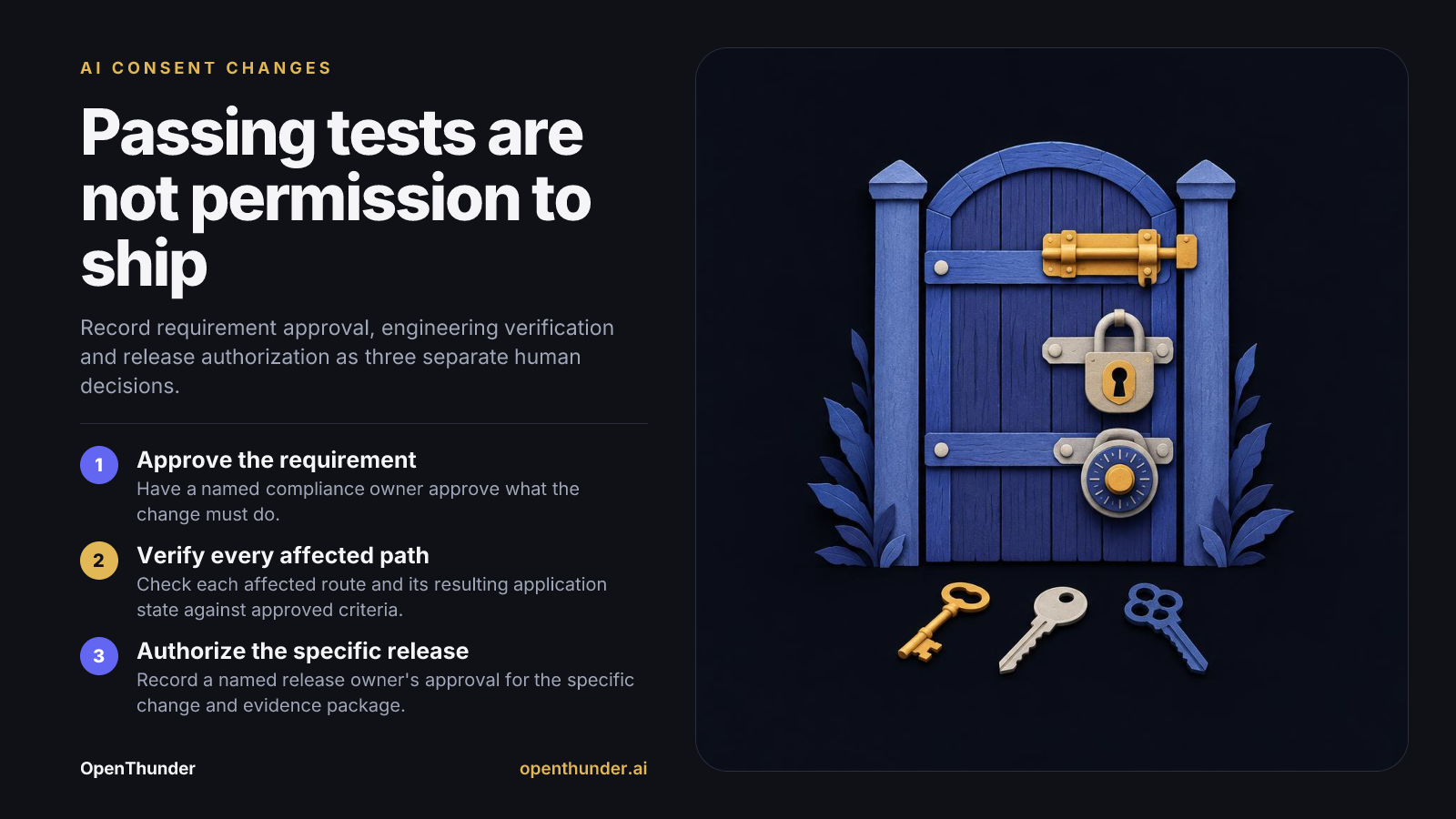
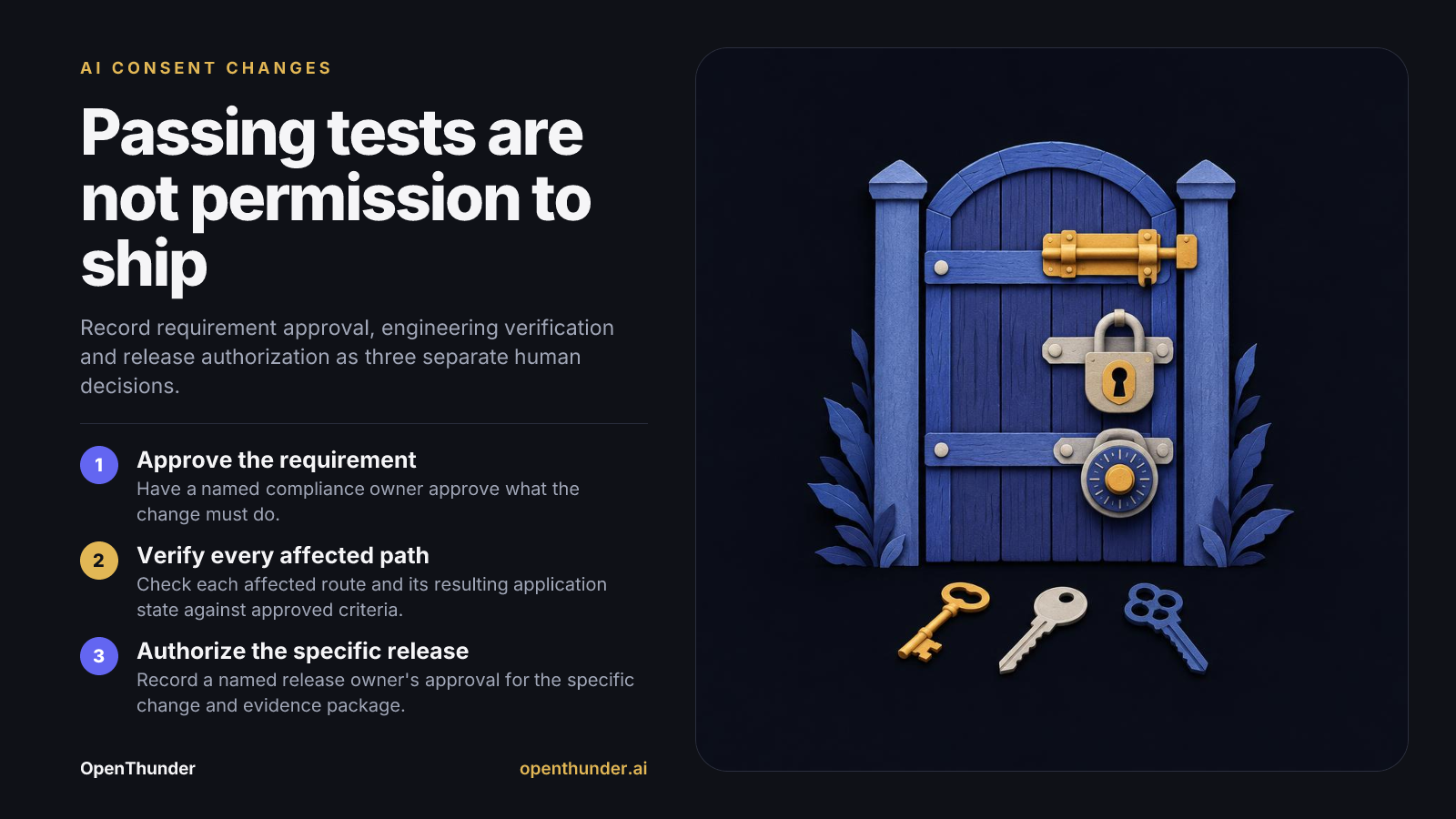
Summary slide. Record requirement approval, engineering verification and release authorization as three separate human decisions. Save the slide (PNG)
In a hypothetical change, an AI coding tool adds a consent screen to email registration, but social sign-up still bypasses it and creates an account. Approving the screen is not the same as approving the flow.
I recommend three separately recorded human decisions: a designated compliance owner approves the requirement, engineering verifies the implementation, and a named release owner authorizes deployment. An AI-generated patch or passing test suite cannot substitute for those decisions.
The boundary is narrow: use AI to implement approved requirements, not to decide what a jurisdiction requires.
Cloudflare’s report provides context, not an AI approval model
In its October 22, 2026 report, Localizing compliance at scale: achieving South Korea’s ISMS certification, Cloudflare reports achieving certification following an audit across 80 controls and describes localizing consent flows and adapting social sign-up paths at the edge. The available publisher excerpt does not establish that Cloudflare used AI coding tools, how it audited these changes, or which requirements governed particular screens. Nor does it establish coverage for subsequent modifications: a previously reported certification is not automatic evidence that a later change is covered.
Separate the meaning of the rule from proof of implementation
A localized consent change contains two different questions:
- Interpretation: What must happen for this jurisdiction, and under which circumstances?
- Implementation: Does the software reliably perform that approved behavior?
Tests can help answer the second question. They cannot establish that the first answer is legally sufficient.
Tests verify an interpretation; they do not authorize it.
This is a recommended governance model, not a cited legal requirement. The decisions must be separate because each approves a different claim: what behavior is required, whether the software implements it, and whether the change may ship. They do not necessarily require separate people.
| Decision | Accountable owner | Required output |
|---|---|---|
| Define the jurisdiction-specific obligation | Designated compliance owner, with legal review where needed | Approved acceptance criteria, scope and unresolved questions |
| Verify the implementation | Engineering owner | Reviewed change, route-level test evidence and documented limitations |
| Authorize production release | Named release owner | Approval tied to a specific change and evidence package |
Put an actual person’s name on each decision in the change record. If one person fills multiple roles, record each decision separately so an engineering sign-off is not mistaken for a compliance determination.
Worked example: one requirement, two sign-up paths
Hypothetical example, not a statement of South Korean law: a team’s compliance owner approves this requirement for a fictional jurisdiction, J:
For new accounts assigned to J, both email and social sign-up must obtain affirmative acceptance of consent text version J-3 before account activation. Existing valid J-3 acceptance must not trigger another prompt. If jurisdiction cannot be determined, activation must pause for resolution.
Assume the jurisdiction-assignment rule and approved text already exist. Changing either is outside this patch’s scope.
The team may use an AI coding tool to implement the gate, connect the social sign-up return path and draft tests. It may not ask the tool to decide whether the text is sufficient, whether an exception applies, or whether another jurisdiction can reuse the same rule.
The engineering owner requests evidence for six cases:
| Entry path | Starting state | Expected result under the hypothetical requirement |
|---|---|---|
| J, no valid acceptance | Activation blocked until affirmative J-3 acceptance | |
| Social | J, no valid acceptance | Return path reaches the same consent gate before activation |
| J, valid J-3 acceptance | Activation proceeds without a duplicate prompt | |
| Social | J, valid J-3 acceptance | Activation proceeds without a duplicate prompt |
| Jurisdiction unresolved | Activation pauses for resolution | |
| Social | Jurisdiction unresolved | Activation pauses for resolution |
For the acceptance cases, the evidence should show both the visible interaction and the resulting application state. A screenshot can show the right words while missing a bypass or an incorrectly stored acceptance version.
Use synthetic accounts in an isolated test environment. These six cases illustrate coverage of the stated requirement, not a complete security, accessibility or reliability test plan.
Suppose all six pass, but a reviewer asks whether an external identity provider’s consent can count as J-3 acceptance. That is a new interpretation question, not an implementation detail. The release remains on hold until the compliance owner approves an answer and engineering verifies any resulting change.
A passing test cannot resolve an undefined requirement.
Copy the Localized Change Approval Card
Attach this card to each proposed change. Keep every decision tied to the same scope, and identify the requirement and implementation revisions each decision covers.
Scope
- Change ID and scope revision: [ ]
- Jurisdiction and affected account population: [ ]
- Affected entry paths, redirects and return paths: [ ]
- Behavior being changed: [ ]
- Permitted AI work: [Implementation and test drafting against approved criteria; specify boundaries]
- Applicable tool and data-use rules: [Link]
- Excluded work: [New obligation interpretations, text changes and jurisdiction-routing changes unless separately approved]
- Recovery plan and evidence link: [How to disable the changed route or restore an approved state; link]
- Consent-record recovery limits: [Records already written and actions needed; do not assume a code revert reverses them]
Requirement approval
- Compliance approver and legal reviewer, where needed: [Names]
- Decision and date: [Approved / changes required / unresolved; date]
- Approved scope revision: [ ]
- Requirement revision and evidence link: [ ]
- Approved consent text version and link: [ ]
- Jurisdiction-assignment rule and link: [ ]
- Required behavior, exceptions and unresolved-state behavior: [ ]
- Open interpretation questions and escalation owner: [ ]
Implementation verification
- Engineering verifier: [Name]
- Decision and date: [Verified / changes required / insufficient evidence; date]
- Requirement revision verified: [ ]
- Tested build or implementation revision: [ ]
- Reviewed diff evidence link: [ ]
- Route-level test evidence links: [Each affected path, including redirects and return paths]
- Interaction and resulting application-state evidence: [Links]
- Untested behavior and other evidence limits: [ ]
- Conclusions dependent on the approved interpretation: [ ]
Release authorization
- Release approver: [Name]
- Decision and date: [Authorized / hold; date]
- Scope revision, requirement revision and release candidate: [ ]
- Requirement approval and implementation verification links: [ ]
- Evidence-package link: [ ]
- Recovery-plan review: [Decision and evidence link]
- Conflicts, undefined exceptions or changed assumptions: [None / details]
- Escalation decision and owner: [Pause affected work; route interpretation questions to the compliance owner rather than automated approval]
The card makes the handoffs inspectable. A reviewer can see whether a decision approves a requirement, verifies its implementation, or authorizes deployment.
Decide separately whether AI may help and whether the change may ship
Use this matrix for the localized change, not as a general rating of an AI coding tool.
| Outcome | Signals | AI development permission | Production release permission |
|---|---|---|---|
| AI development allowed; release eligible for approval | Approved criteria cover affected paths; named owners accept responsibility; implementation evidence matches the release candidate | Work within approved scope and existing tool rules | Only after all three decisions are recorded for that scope and candidate |
| Restricted AI pilot; release blocked | Requirement approved, but route-level verification is not yet adequate | Develop the patch and evidence using synthetic accounts and isolated resources | No production release until verification and release authorization are complete |
| Affected change on hold | Obligation, jurisdiction rule or exception ambiguous, or accountable owner missing | Do not use AI to fill the missing interpretation or approve affected behavior | No release; escalate the missing decision |
I would allow AI assistance for a bounded implementation with explicit criteria. I would not allow it to infer a missing local obligation from existing code or another market’s screen. That can produce an internally consistent implementation without establishing that its interpretation is appropriate.
Try a five-minute approval check
Take one pending localized sign-up change and write four lines: the approved requirement, every affected entry path, the evidence that each path follows it, and the name of the release owner.
If a line is blank, classify the gap before adding more automation. Missing interpretation needs a compliance decision. Missing route evidence needs engineering verification. Missing ownership needs an explicit assignment.
This exercise exposes approval gaps; it does not determine legal sufficiency or replace a full review.
Save the field guide
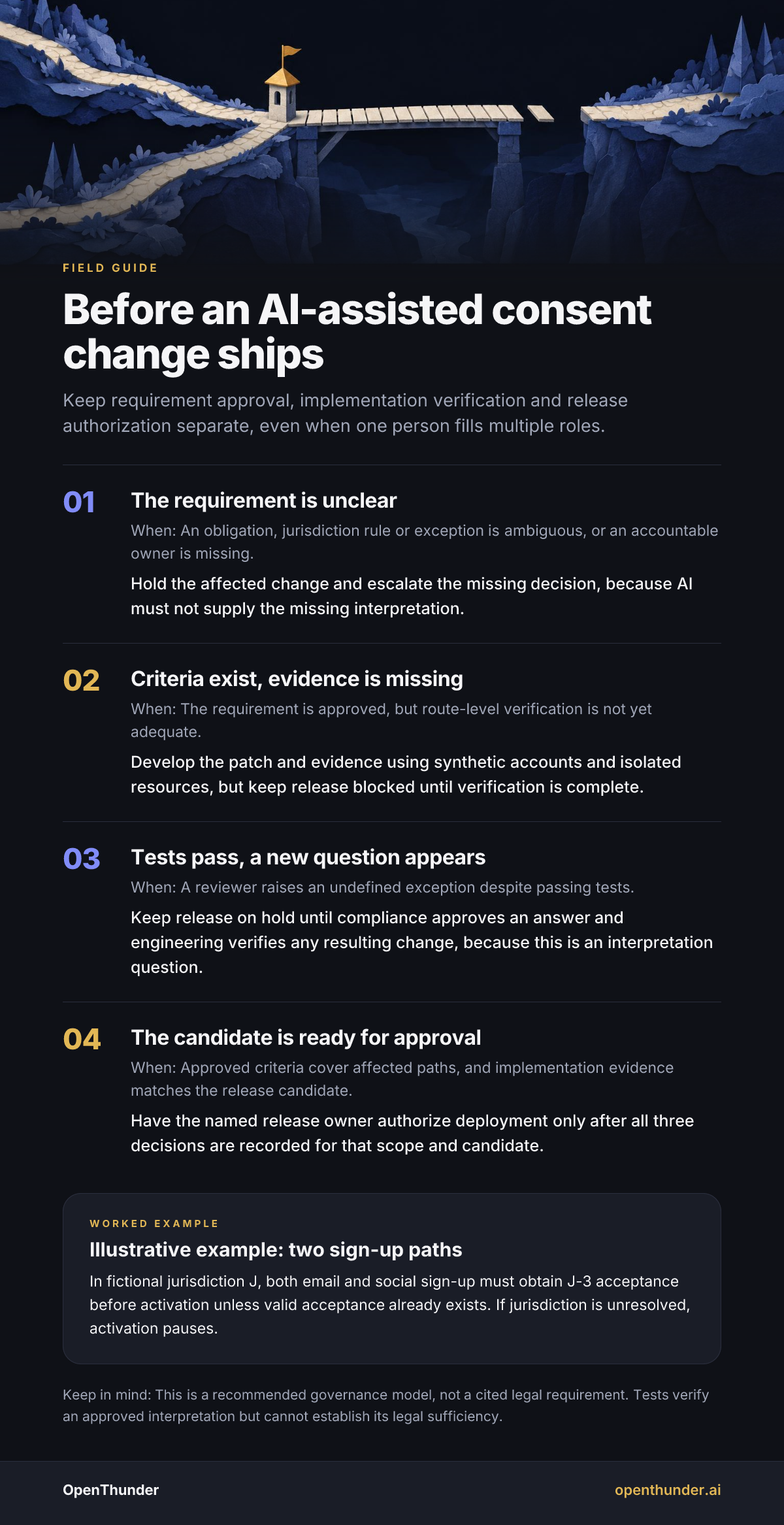
A field guide distilled from this article. The text version follows below.
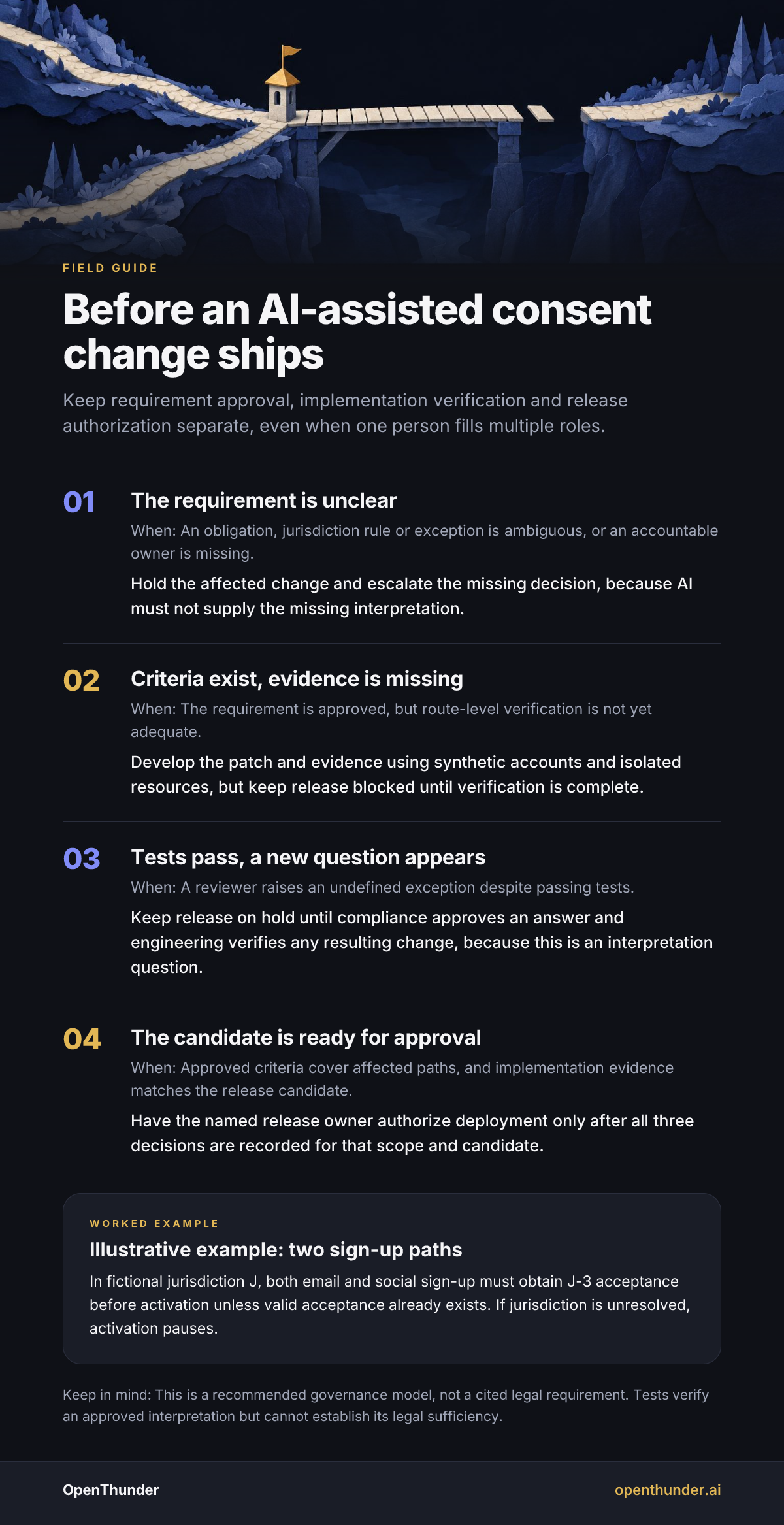
Text version
- The requirement is unclear: An obligation, jurisdiction rule or exception is ambiguous, or an accountable owner is missing. Hold the affected change and escalate the missing decision, because AI must not supply the missing interpretation.
- Criteria exist, evidence is missing: The requirement is approved, but route-level verification is not yet adequate. Develop the patch and evidence using synthetic accounts and isolated resources, but keep release blocked until verification is complete.
- Tests pass, a new question appears: A reviewer raises an undefined exception despite passing tests. Keep release on hold until compliance approves an answer and engineering verifies any resulting change, because this is an interpretation question.
- The candidate is ready for approval: Approved criteria cover affected paths, and implementation evidence matches the release candidate. Have the named release owner authorize deployment only after all three decisions are recorded for that scope and candidate.
Illustrative example: two sign-up paths: In fictional jurisdiction J, both email and social sign-up must obtain J-3 acceptance before activation unless valid acceptance already exists. If jurisdiction is unresolved, activation pauses.
This is a recommended governance model, not a cited legal requirement. Tests verify an approved interpretation but cannot establish its legal sufficiency.